The CarbNETs Project (Carbon Capture, Thermal Energy Management and Electrification Using Net-Zero Industrial Technologies for Decarbonisation) officially kicked off with the inaugural meeting of the project consortium. The project focuses on the development of advanced technologies for industrial decarbonisation. Coordinated by the National Institute of Chemistry, the consortium brings together 20 organisations, including TECOS Slovenian Tool and Die Development Centre. Its primary objective is to accelerate the green transition by reducing carbon emissions from industries that are among the world’s major sources of CO₂ emissions.
CarbNETs is developing innovative solutions to improve energy efficiency in energy-intensive industries, such as the chemical and construction sectors, while supporting the transition towards a low-carbon and circular economy. The project is structured around five interconnected research areas:
- Novel CO₂ capture technologies,
- Conversion of CO₂ into green chemicals,
- Advanced bio-based materials,
- Circular heat and water management,
- Horizontal Techno-Economic Assessment (TEA) and Life Cycle Assessment (LCA) to support circular economy integration and prepare technologies for market uptake.
These areas comprise 16 research and development projects (R&D projects) in which the project partners are jointly developing advanced sustainable technologies. The consortium aims to deliver at least 37 new products and services, reaching TRL 6, validated in industrially relevant environments and further advanced towards TRL 9. By combining expertise in chemistry, materials science, process engineering and industrial applications, the project seeks to develop practical and sustainable solutions for the industries of the future.
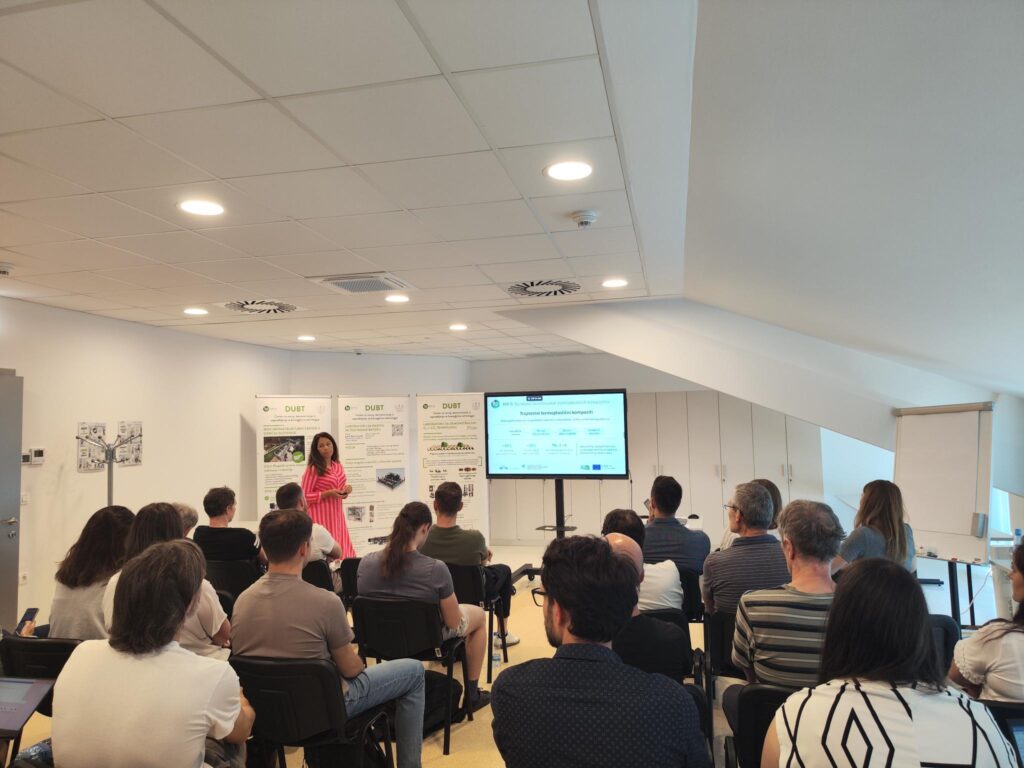
Within the project, TECOS leads a dedicated work package focused on the development of sustainable thermoplastic composites for the automotive, electrical and caravanning industries. Based on recycled and bio-based polymer matrices reinforced with natural fibres, the work package aims to develop functional biocomposites using secondary raw materials and renewable resources. These solutions will contribute to reducing the carbon footprint while supporting the implementation of circular economy principles, enabling more efficient, sustainable and cost-competitive manufacturing of next-generation industrial products.
The CarbNETs project represents an important opportunity to strengthen collaboration between research organisations and industry in addressing one of the most significant challenges facing modern manufacturing – industrial decarbonisation. Through joint research and innovation, the consortium is laying the foundation for technologies that will support Europe’s transition towards a climate-neutral and resource-efficient industry.
Read more about the CarbNETs project HERE.